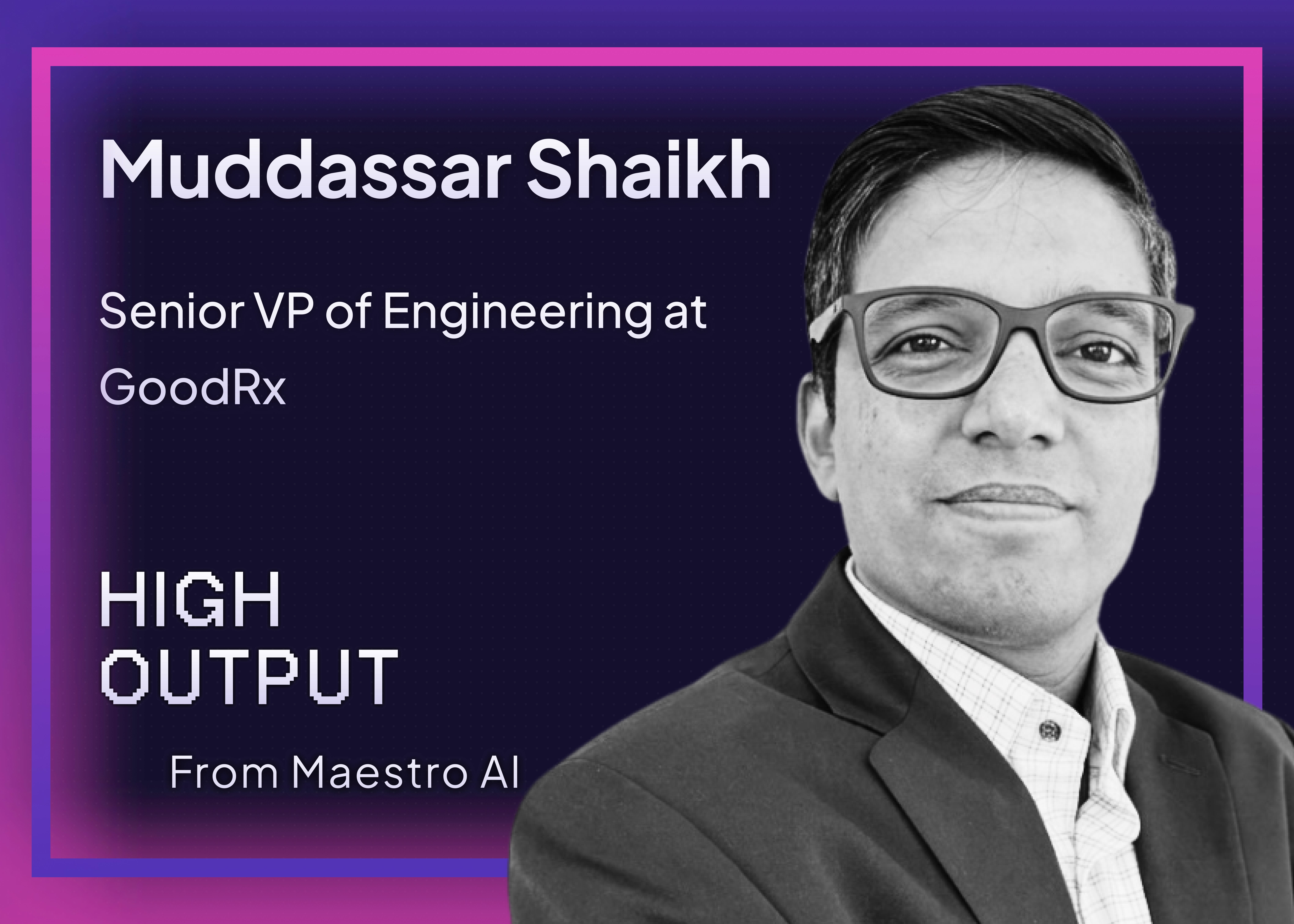
The Handoff Tax

I asked Muddassar Shaikh where engineering work is actually heading, and he answered with what he admitted could be the setup to a joke.
“This can be the start of a great joke,” he said. “A product manager and a designer and an engineer walk into a room, and then jam on the idea together. And they come out with a working prototype instead of coming out with a spec.”
What’s missing is the handoffs. No PRD for a designer to interpret. No mockups for an engineer to build from. No ticket waiting to be picked up. The session ends with a thing that runs, not a document describing the thing that should run. He kept returning to that image, and most of our conversation was about the distance between that room and the one his teams actually work in.
Muddassar is the SVP of Engineering at GoodRx, with two decades behind him — Ticketmaster, where he grew the app install base to 42 million users, then Beachbody, now GoodRx. He’s led the kind of multi-year migrations that reshape an org chart, and so his first instinct about AI is that it’s familiar. “I would say this is part of my playbook,” he said. “I’ve led technology transformation and organizational transformation at a number of companies.” Cloud was one. Monolith to microservices was another. AI, in his telling, is just the next. Hold onto that, because by the end he complicates it himself.
Leakage
When I asked him to walk through how software actually gets made at GoodRx, the answer ran long. A PM talks to a business stakeholder. The ideas become product specs. The specs get handed to a designer, who makes visual artifacts. Those go to an architect or tech lead, who writes the technical diagrams. Then a team builds it.
Business intent into PRD. PRD into wireframes. Wireframes into architecture. Every arrow is a person reading what the last person produced and trying to figure out what they meant.
There’s “a lot of potential of leakage,” he said, as “these handoffs are happening between different roles.” Leakage is the right word for it. Each handoff is a lossy compression: the stakeholder had something in their head, the PM wrote down a version of it, the designer drew a version of that, the engineer built a version of that, and what ships is four translations downstream of the original intent. No single handoff is broken in a way you can name. But by the time the thing reaches production, some real fraction of what the business actually wanted has been quietly washed out of it.
Muddassar’s read is that AI’s real leverage is on the chain itself, not on the code at the end of it. “What AI will do, already doing, is diffusing these different roles. So one person can play multiple roles. We can also find ways to reduce the leakage as handoffs go on. Or we can completely eliminate certain handoffs.” Most productivity tools just speed handoffs up. He’s saying some of those handoffs shouldn’t exist in the first place.
Collapsing the chain
That room from the joke — GoodRx isn’t in it yet. “We are not there yet,” he said. So he’s working toward it one handoff at a time. He gave me three examples, each killing a different translation step.
JIRA automation closes the gap between a ticket and a branch: “add a label, or add a bot. It’ll read the JIRA specification. It’ll recognize what parts of the code need to change. It’ll go make the changes.” A tool his team open-sourced, called Lifecycle, shortens the engineer-to-QA loop by spinning up an ephemeral environment for every PR and posting the test link back to the ticket. And the third handoff isn’t technical at all: “We’ve had a lot of product managers starting to deploy quick fixes. AI has truly enabled me to democratize access to code.” For a copy change, the PM just ships it. The handoff to engineering disappears.
Each one cuts out a step that used to be just how work moved through the org. You make progress by subtracting, and the subtractions stack. His last transformation cut cycle time from “13 days or so to about six days,” and “that took us about two and a half years.” Since adopting AI: “the cycle time has again reduced by half in the last eight months.” Same size of gain, a quarter of the time.
Two workforces
This is where his just-another-transformation framing breaks, and he knew it.
“Previous transformations were primarily human driven. And now you have to manage humans, and you have to manage non-humans — the agents.” There’s a second workforce in the org now. It doesn’t attend standup, isn’t bound by morale or meeting culture, and runs at a pace no migration ever did. A cloud migration never made anyone manage a fleet of teammates that don’t sleep — and it never made the human teammates wonder, as Muddassar put it, whether “this role is even going to be around two years or five years from now.”
So a leader now runs two workforces at once, and can see neither clearly. The pace is the part that surprised me — Muddassar told me he used to read a daily brief on the AI world and had to give it up for a weekly one, because there was too much shipping in any given day to keep up with. And the humans? Their most important work has moved to a place the old dashboards don’t look. When the act of coding gets cheaper, the value moves upstream of the code: into how an engineer scopes a problem, what they ask the model, whether they catch it when it’s wrong. As Muddassar put it, “the act of coding itself will become less and less important.” What survives is “system thinking” and “your ability to give really clear specs.” That work happens before a single line is committed — and none of it shows up in a PR count.
The one handoff you can’t collapse
For all the acceleration, the thing he was most insistent on was the part that doesn’t speed up. With more code generated by models — and then read and changed by models — the old review process strains. But the answer isn’t a lower bar. “The bar for product quality cannot reduce. So we have to have stronger harnesses to test the changes.” He’s seen the cautionary tales: “changes at much bigger companies being rolled out with AI that have caused business impact.”
His reframe is that the code itself stops being the artifact you guard. “The quality of code will matter less and less. The outcome that comes out of the coding session, the final output — that’s gonna matter. If you’re able to write a well-defined spec, and if you have well-architected harnesses to evaluate the output of the prompt, then how the code is actually written matters less and less.” Not how it’s written. Whether it does the thing, and whether you can prove it.
If the leverage is in collapsing handoffs, the one handoff you can’t collapse is between “the model produced something” and “we know it’s right.” That one you have to build deliberately, stronger than before.
High Output is brought to you by Maestro AI. High Output is brought to you by Maestro AI. Muddassar described leaders running two workforces at once — the humans and the agents — and being able to se neither clearly. The agents are the newer blind spot. Teams are all-in on AI with almost no view into how it’s actually being used: what’s working, what’s wasted effort, and which engineers have learned to direct an agent well.
Maestro plugs into Claude Code and Codex and gives you that view. The point isn’t to grade your engineers — it’s to help every one of them get better at directing AI. We see what your strongest AI users actually do differently and turn it into patterns the rest of the team can learn from, so every engineer on your team can master AI.
Your team adopted AI. Maestro helps you see how it’s really going — and helps every engineer learn to direct an agent well.
Thank you for subscribing. Share this episode.