Stop writing code. Start reading it.

We recorded this episode with Steve back in October of 2025, before he invented Beads and Gastown. Several of his predictions have aged well in the months since.
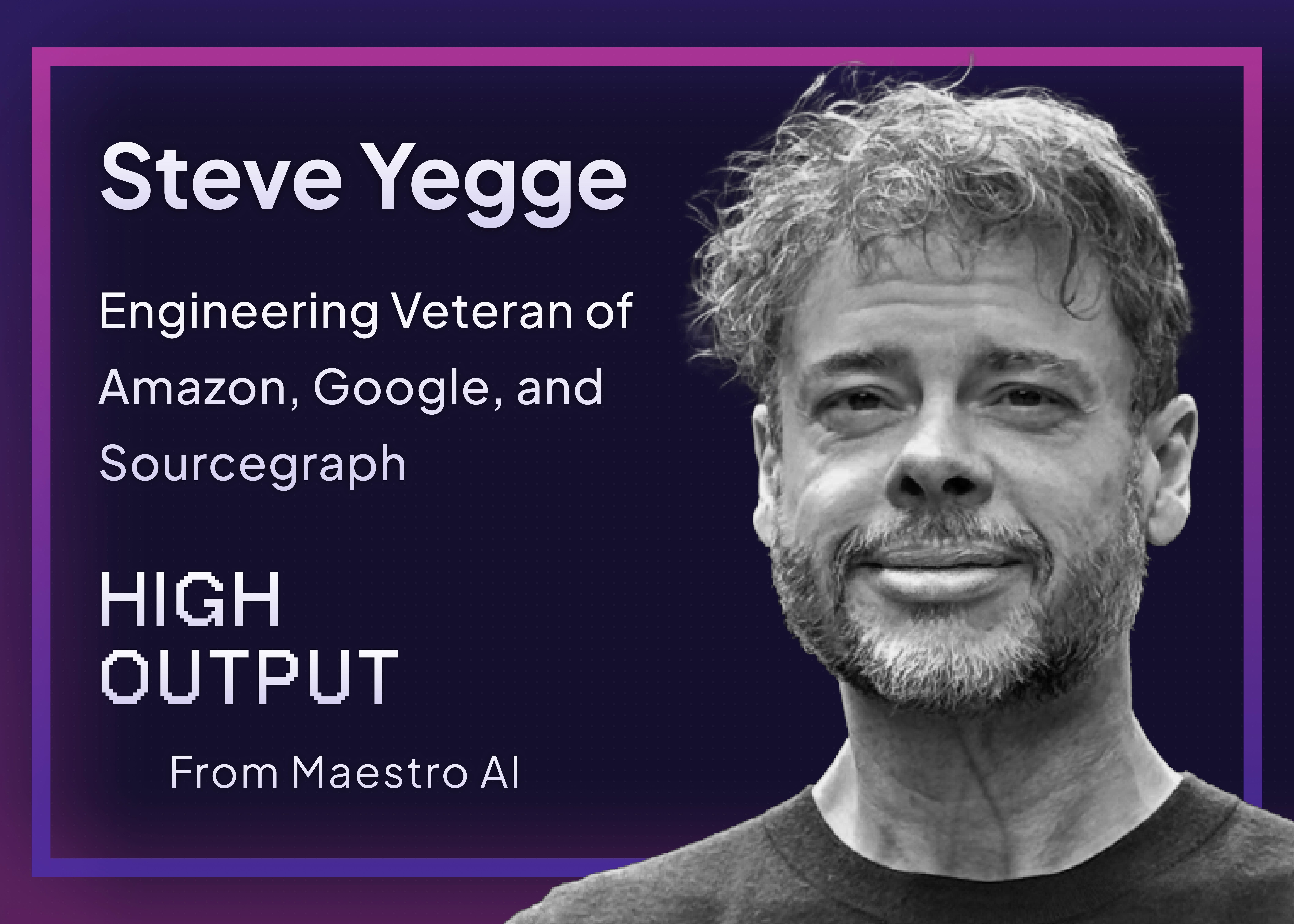
Steve Yegge has been VP or head of engineering at four companies. He keeps stepping down on purpose.
Not because things went wrong — his organizations were doing well. He’s the kind of leader whose reputation travels through a company; at Amazon, at Google, engineers lined up to transfer onto his teams. He stepped down each time because he noticed the same thing: the moment he stopped being able to code alongside his engineers, conversations started requiring translation. Once you’re in translation mode, Yegge figured out, you’re not leading anymore. You’re triangulating toward an answer you don’t fully understand.
In the AI era, he thinks this problem just got much more expensive.
The translation layer
When Yegge handed over the engineering org at Sourcegraph — his fourth deliberate step-down in a career that spans Amazon, Google, and Grab — he gave a specific reason. “I was going through a translation layer with my engineers where they’d be like, ‘Well, you see the AI does this, and then I do that, and then the AI does that, and then there’s a gateway’ — and I’m like, what?”
It wasn’t that he didn’t trust his engineers. It was that he’d lost the ability to sense-check them. And he’d noticed what happened to leaders who stayed in that position too long: “That’s a technique that non-technical leaders use. People who’ve lost their technical chops, they can still be effective leaders, but they have to be very good at triangulating, almost like a GPS on the right answer by going to different technical people and getting it.”
Triangulation is better than nothing. But it’s slow, and it requires your engineers to speak in executive-friendly summaries, which means you’re always one abstraction layer removed from what’s actually happening.
Yegge’s response has been consistent across his career: hand the org to someone ready to take it, go back to IC, get his hands back in the code. At Sourcegraph that meant 18 months as an individual contributor during the period when AI coding changed the most — which is exactly when he made the predictions that got Anthropic’s attention.
His observation about himself is worth sitting with: his most accurate forecasts came during IC phases, not executive phases. Proximity to the work makes the signal cleaner.
The “Otherwise” has arrived
The case for technical proximity isn’t just philosophical anymore. Yegge has data.
Andrew Glover, Director of Productivity at OpenAI, shared findings with Yegge and his co-author Gene Kim: at OpenAI itself, engineers who adopted Codex — their fully agentic CLI coding tool — are producing pull requests that, even accounting for higher rejection rates, “dwarf the contributions of the people who aren’t doing agentic coding by an order of magnitude. Ten times as many commits.”
The interesting part isn’t the 10x number. It’s where the 10x is and isn’t happening.
“The ones who are successful with agentic coding were the ones living in the microservices world, where there’s lots of small, well-factored bits of software. The ones who are struggling are the folks in ChatGPT Land, which is one of the world’s largest monoliths.”
For a decade, engineers warned that monolithic codebases would become a liability — every warning came with an implicit otherwise at the end: refactor now, or else. But the or-else never arrived. You could run with a monolith indefinitely; deployment was easier, QA was simpler, everything just “floated off and got deployed somewhere.” The warning was technically correct but operationally optional.
“You didn’t refactor it. And so what we’re faced with right now is this rat race where first of all, everyone who’s already in microservices land is just being pigs. They can use all the tokens they want. AI is working for them beautifully. The ones with monoliths — and you just point at any company and they have a monolith — it is time to break them up.”
The otherwise, he says, has finally arrived. A 2025 METR study found that experienced developers were 19% slower when using AI tools on large, real-world repositories — the kind of environments where monoliths live.
What Bezos actually understood about services
Yegge built some of the original infrastructure that justified Amazon’s service-oriented architecture, so he has a view on why Bezos pushed it so hard in the early 2000s that most people don’t know about.
It wasn’t primarily an engineering decision. “I heard this later from a colleague at Amazon. Jeff had come from D.E. Shaw on Wall Street, and D.E. Shaw is a company that buys companies and breaks them up and sells the pieces off for a huge profit. He was worried that Amazon was gonna die because of the dot-com bust. And so what he wanted to do, as a last resort, was I’m gonna bust Amazon up and sell the pieces. Which means every one of them has to have a service interface.”
An exit strategy for a dying company accidentally created the architecture for a trillion-dollar one.
Bezos wasn’t playing chess when everyone else was playing checkers — he was scared. The mandate came from a Wall Street M&A playbook, not a software architecture philosophy. Modular design was a byproduct of an exit strategy. The companies that invested in microservices over the past decade for code organization reasons are now discovering they got AI compatibility for free. The companies that didn’t are discovering the bill is coming due.
The “Dial”
Yegge has a name for the decision every engineering leader is quietly making right now: the Dial.
“Every company has been given a dial that goes from zero to a hundred, and it is the number of engineers that you’re gonna fire in order to pay for the rest of them to have AI.”
He’s not being glib. If a subset of your engineers can produce 10x the output with agentic tooling, and those tools require meaningful investment in compute and licensing, the question of headcount allocation is already embedded in your budget decisions. You’re turning the dial whether you’re thinking about it explicitly or not.
Most companies aren’t thinking about it explicitly. Yegge thinks that’s a mistake. “Once you finally figure out how coding is done today — with Codex, with Claude Code, with Sourcegraph Amp — you switched into that world. You are playing in the big leagues and everyone else is falling behind.”
The dial isn’t just about AI spending. It’s about what you believe your engineers will be doing in 18 months.
Writing code is for agents
Which brings Yegge to his single most concrete piece of advice: stop spending your energy on writing code. Start spending it on reading code.
“You’re gonna be generating 10 to 100 times as much code as you ever did before, and you’re gonna need to read it at some point because you need to own it.” Addy Osmani, VP of Engineering at Google Chrome, calls the alternative “comprehension debt” — the accumulation of plausible-looking code you’ve approved without truly understanding, a debt that comes due when something breaks at 2am and you can’t trace why.
The shift is real and immediate. Yegge has already made it. He describes his current workflow as watching his agents code — actually sitting there, following the diffs, paying attention to what they produce — rather than writing much himself. “Turn off permission checks so you don’t have to hit enter all the time and just watch it. Watch it code. Pay attention to the diffs.”
The skill of reading code fast and evaluating it accurately — is this correct? Does this make sense architecturally? Would I defend this in a code review? — is what separates a developer who’s a good director of agents from one who’s just vibe coding at scale and hoping for the best.
Yegge’s analogy: a musician who practices sight reading every day for 10 minutes compounds that skill faster than someone who only practices composition. The reading muscle and the writing muscle are different. For most developers, the writing muscle is heavily developed and the reading muscle isn’t, because historically writing was the job. That’s the ratio that’s inverting.
What this means to you
If you’re a leader who has drifted from direct technical work, the cost of that drift just increased. AI coding is changing fast enough that managing by summary will leave you making decisions you don’t understand. You don’t need to write the code — but you need to be able to read the diffs.
Ask whether your codebase is AI-ready. Not “are we using AI tools?” but “can an agent work effectively in our codebase?” The answer is mostly a function of modularity. If your engineers are struggling to adopt agentic coding, the problem is probably architectural, not motivational.
Have an explicit conversation with your leadership team about how AI changes the headcount math. Not as a cost-cutting exercise, but as a forcing function for getting clarity on what you believe your engineering team will look like in two years. Leaving this implicit means it gets decided by budget pressure instead.
And if you’re an engineer: watch your agent work. Follow the diffs. Treat it like sight reading practice. The engineers who can evaluate agent output quickly — who own what the agent ships — will be the ones who remain indispensable as the generation overhead approaches zero.
High Output is brought to you by Maestro AI. Steve Yegge talked about the “translation layer” that forms when leaders drift from the code — but there’s a deeper version of that problem right now. Every engineering leader knows AI adoption is happening. What they can’t see is whether it’s working. Token counts and PR velocity tell you who’s generating more. They don’t tell you who’s actually using AI well.
Maestro analyzes the AI sessions themselves, scoring how effectively each engineer is working with their tools — so you can see who’s genuinely leveling up and who’s just generating noise. Visit https://getmaestro.ai to see how we help engineering leaders measure AI effectiveness, not just AI activity.
How are you thinking about the difference between AI adoption and AI effectiveness on your team? We’d love to hear your story. Schedule a chat with our team → https://cal.com/team/maestro-ai/chat-with-maestro
Thank you for subscribing. Share this episode.